
Build a Franklin Deed Timeline
Start with the newest deed. Add each earlier transfer as its own row. When the online card offers only a date or book and page clue, never guess at a party name.
| Transfer date | Grantor to grantee | Deed type | Book or page |
|---|---|---|---|
| Newest conveyance | Latest grantor to current grantee | As recorded | Capture exact reference |
| Prior acquisition | Earlier grantor to that same party | As recorded | Repeat by legal description |
| Older book entry | Indexed parties from office volume | Warranty, quitclaim, trustee, or other | Book and page |
| Historic collection | Party trail in KSHS finding aid | Deed, probate, or court record | Collection and reel |
The Register of Deeds holds land records reaching into the 1860s. It publishes no online grantor-grantee index.
Tyler Supplies Franklin Deed Clues
The assessor card is not a deed index. Its sales tab can still show a date, instrument, deed type, and book/page. Sample parcel R3371 lists a 2023 warranty deed and a 2015 trustee's deed. Treat these as clues only. The card never exposes a complete grantor-grantee chain. Copy each reference, then ask the Register of Deeds for the recorded instrument and the index entries around it. That grantee becomes the next name to search.
Franklin Legal Descriptions Persist
Street numbers change. So do owner names. The legal description is what holds the chain together. Keep the addition, lot, block, section, township, range, tract, acreage, and every metes-and-bounds exception exactly as the deed states them. County guidance is blunt: tax-statement shorthand is not sufficient for a deed, so use the full recorded description. A replat or split changes the wording, so link old and new parcels through their plat references instead of assuming a modern PIN existed in earlier books.
See the Franklin Recorder Route
Review the Franklin County Register of Deeds page before an office search.
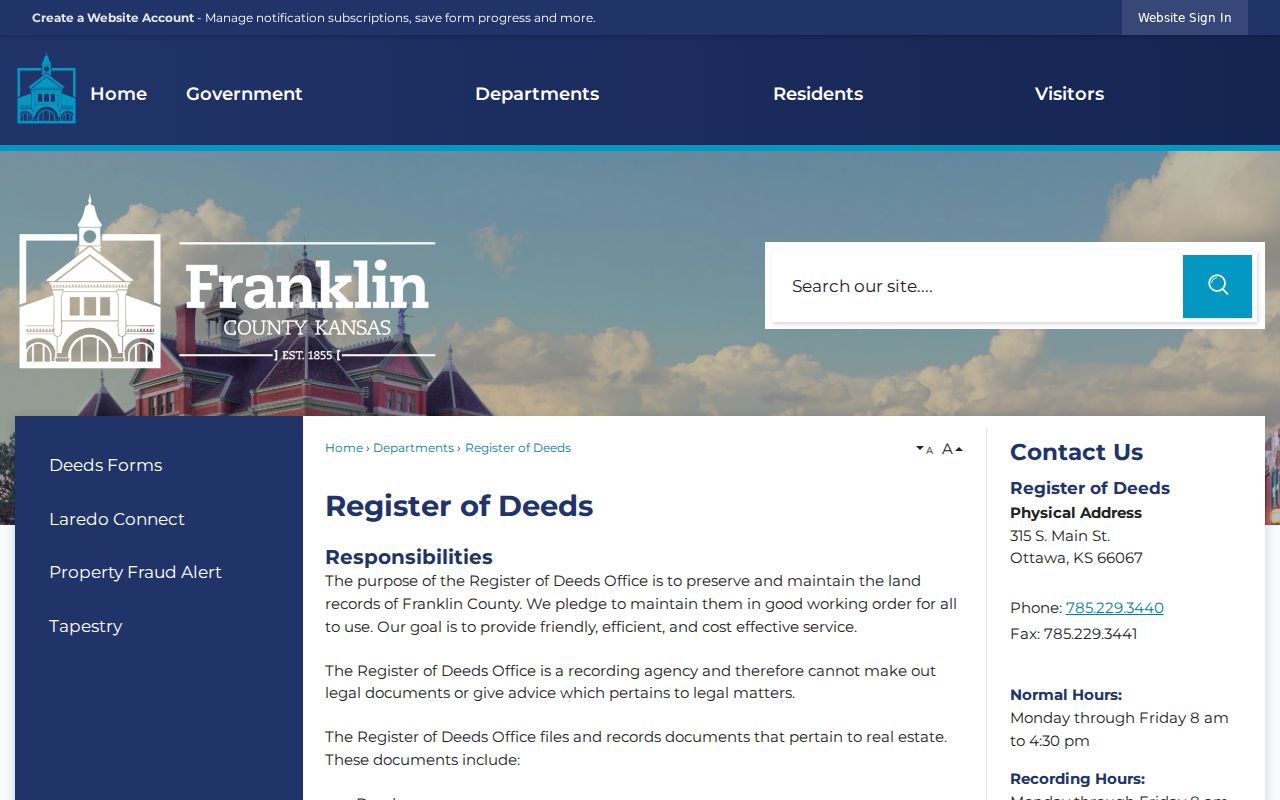
The recorder's office page lists its land-record duties, though many deed indexes and books stay in office only.
Ottawa.s Older Deed Index
The Kansas Historical Society finding aid covers county deed records from 1857 through 1904. A separate Ottawa city deed index runs from 1865 through 1904. Those dates describe the collections. They do not promise online images. The city index shines for Ottawa additions. Search the name and addition. KSHS also lists probate, civil court, naturalization, and cemetery collections that explain transfers beyond a simple sale.
Ottawa Plats Preserve Prior Names
Woodridge Estates paperwork points back to Riverview Addition, Davis Avenue Addition, Simons Subdivision, Fairway Vista, and other recorded references. One modern tract can carry generations of plat names. This is plat archaeology, Ottawa style. Chase each cited plat slide and instrument. Then align the lot and block wording with the deed chain. Search only the newest project name and you will miss former owners whose deeds cited an older addition.
Estates Interrupt Franklin Chains
Death interrupts a deed chain in messy ways. Look for executor deeds, trustee deeds, affidavits, and probate orders. When a deed names an estate, stop the name loop. Check the Franklin District Court or a courthouse terminal for the case record. Kansas law separately restricts vital certificates, which are not open land records. A probate order or recorded death affidavit can supply the property link. It does so without confidential vital-record access.
Reverse the Franklin Deed Chain
Work backward from the newest deed. Find the current owner's acquisition, read the prior grantor, then locate the deed by which that grantor first took the same land.
- Find the current owner's acquisition deed.
- Read its grantor and full legal description.
- Search that grantor as an earlier grantee.
- Repeat in deed books when online clues end.
- Grantor
- The party conveying an interest.
- Grantee
- The party receiving that interest.
- Chain of title
- The ordered sequence of instruments affecting the land.
- Reverse index
- An index organized to help trace parties in the opposite role.
Depth of Franklin Ownership Records
Two different claims describe the county's depth. The finding aid starts deed records in 1857. The recorder's broader statement puts physical holdings into the 1860s. Those are not identical claims, so keep them distinct. For owners beyond the modern cards, turn to the recorder vault, KSHS paper and microfilm, and court files. When access goes office-only, the web search ends but the ownership trail does not.
Lawful use. Former-owner research supports house history, estate work, and property diligence. Never use it to track or harass a living person.
Franklin Searches Continue Offline
No online grantor-grantee index exists. That is an access limit, not a gap in the county's story. Bring a party name, legal description, instrument type, and rough year to the Register of Deeds. Staff explain how records work. They will not build the chain for you. Archival-era research should cite the KSHS collection title and year run with each result. Probate files, dockets, plats, and deed books differ. Together they may explain one transition, but none works as a universal owner index.
Cite each instrument, party spelling, legal description, and source location in a final chain log. Another researcher can then repeat your backward search. Historic spelling matters, so copy names exactly. Test variants only as separate searches, and never merge two parties just because their names look alike.