
Fields in Franklin County Property Tax Records
The Tyler property portal covers a lot of ground. Values, exemptions, bills, payment history, sales entries, and parcel details all sit there, while the Appraiser sets class and value, taxing entities set levies, and the Treasurer bills and collects.
| Field | What It Shows | Where |
|---|---|---|
| Assessed value | Class-adjusted taxable base | Appraiser |
| Appraised value | Market-oriented land and building valuation | Appraiser |
| Exemption and class | Tax treatment shown on the parcel | Appraiser |
| Bill and status | Charges, due amounts, and statement history | Treasurer |
| Taxing units | County, city, school, state, and special levies | Treasurer |
Appraised value reflects market-oriented valuation. Assessed value applies the Kansas property-class percentage to produce the taxable base. Neither one predicts a sale price, and neither is the confidential sales-validation questionnaire. Compare figures only within the same tax year and the same parcel class.
One Franklin County Card Separates Land and Building Values
One Franklin County card makes the split plain. The R3371 card at 1003 N Main lists a 2026 appraised building value of $126,070, appraised land of $32,470, and an appraised total of $158,540. Assessed building, land, and total figures appear separately, with a $39,636 assessed total, and the history reaches back through 2022. The official R3371 record shows it all.
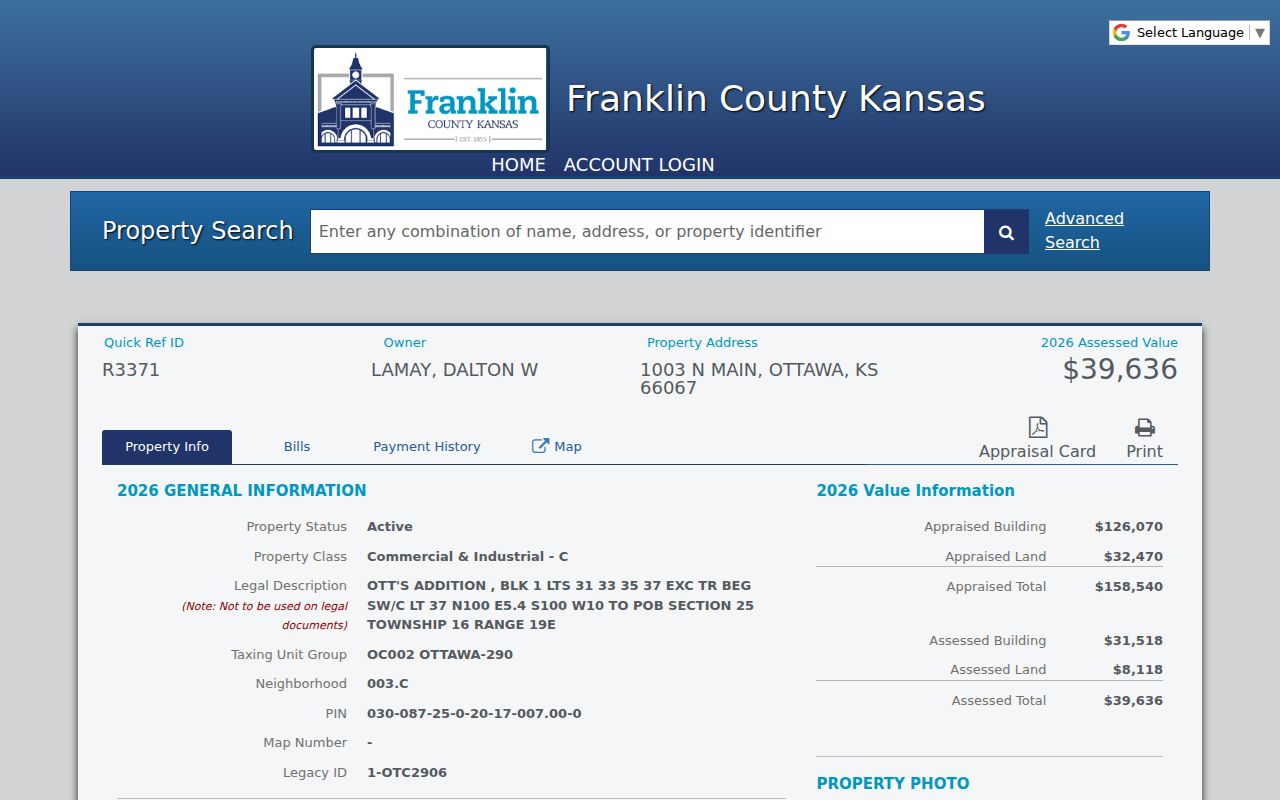
Its class, Commercial & Industrial-C, explains the different ratio from a residential parcel.
Exempt Does Not Mean No Franklin County Appraised Value
R5261 belongs to Franklin County, Kansas. Its appraised total runs near $5.9 million. The courthouse parcel carries an Exempt-E class, so its assessed taxable total is zero. That is why ownership, class, appraisal, assessment, and bill should be read as separate fields on every Franklin County parcel.
Appraised value is the market-oriented figure. Assessed value applies the class percentage to the taxable base. A levy is a taxing entity's rate, while a tax lien is a recorded or statutory claim tied to unpaid tax, never the same as a displayed current bill.
Look Up a Franklin County Tax Bill
In the Tyler portal, search by address or property identifier and open the correct parcel. Then choose Bills or Payment History. Match the tax year to the parcel card. Balances can lag by as much as 72 hours, so call the Treasurer at 785-229-3450 for an accurate current payoff.
- Search Tyler by address, Quick Ref ID, or RE Tax ID.
- Read the selected year's bill, prior statements, and displayed payment history.
- Compare exemptions and class on the Appraiser record.
- Note delinquency, then check the county foreclosure page and court record when a sale process is involved.
- Assessed value
- [Definition - the taxable portion.]
- Mill rate / levy
- [Definition - how the tax is computed.]
- Homestead exemption
- [Definition - owner-occupied relief.]
- Tax lien
- [Definition - claim for unpaid taxes.]
Franklin County Tax Payments Have Several Channels
The Treasurer takes Franklin County tax payments several ways. You can pay online, by mail to 315 S Main Room 107, at the office, or through the drop box in front of the Historic Courthouse. Posted 2025 statements list December 22, 2025 for the first half and May 11, 2026 for the second. Those are specific posted dates, not universal deadlines.
Online payments carry extra fees. The 2025 statements showed ePay tiers. These included a $4 Visa debit fee, a $30 returned eCheck fee, and a 2.55 percent card fee with a $2 minimum. Charges can change. Verify the live fee screen before paying. The Treasurer's page posts statements and the current fee schedule.
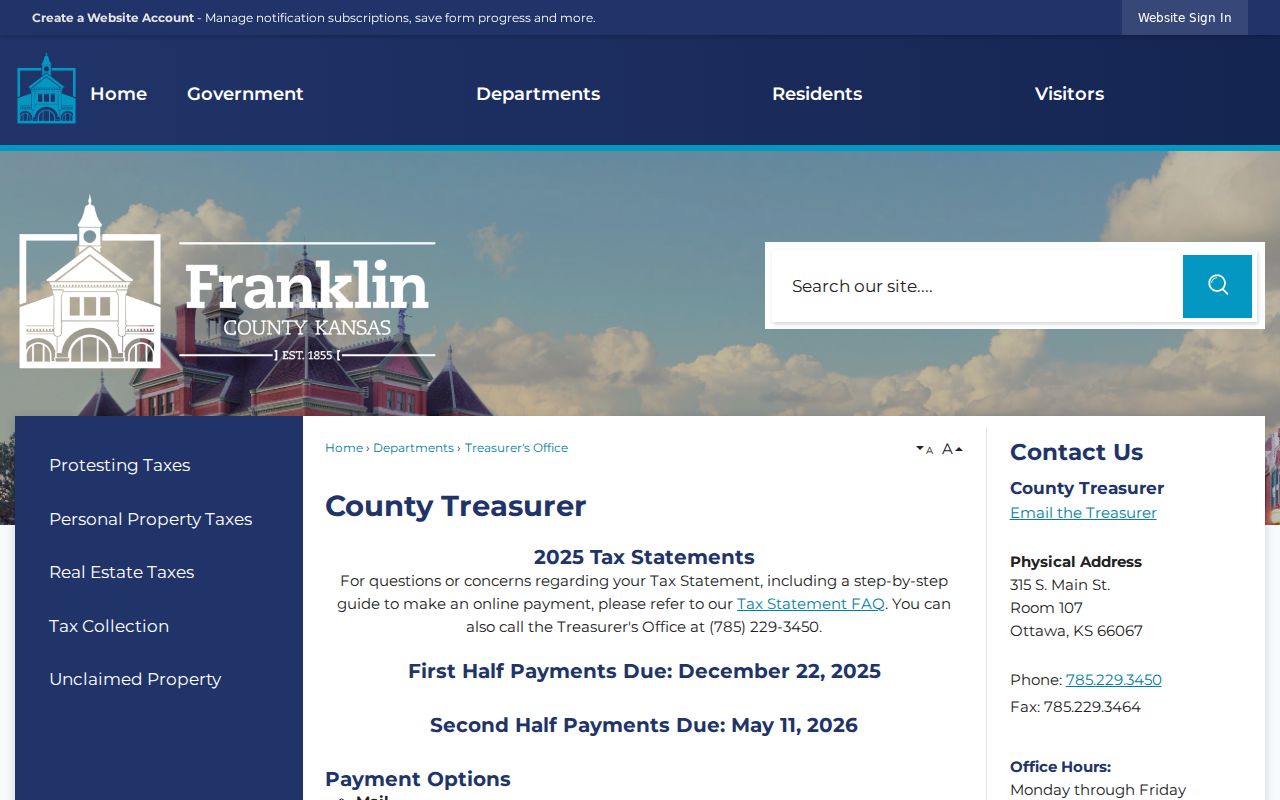
The office route matters most when the web balance and a recent payment do not agree.
Kansas Classes Change Franklin County Assessed Value
Kansas applies classification percentages to appraised value. Residential parcels run at 11.5 percent. R3371 shows a 25 percent commercial relationship. So two Franklin County parcels with the same appraised total can carry different assessed values before any levy applies.
Read Property Class beside the land, building, and total figures. R3371 sits in Commercial & Industrial-C. R5261 is Exempt-E with a zero assessed taxable total despite a large appraised amount. An exemption changes tax treatment, not the parcel's existence or its market-oriented appraisal.
The Appraiser does not set taxes. Taxing entities set the levies. The Clerk maintains accounts and applies special assessments. The Treasurer bills and collects. Keep each number in its stage.
Franklin County Taxing Units Build the Bill
R3371's 2025 tax detail breaks the bill into separate lines. The county, Frontier Extension #11, Ottawa City, and Kansas each appear with a rate and a charge. Assessed value alone cannot rebuild the bill without the right taxing-unit group and that year's levies.
The card names group OC002 OTTAWA-290. A Franklin County parcel across a city, school, extension, or special-district line may carry a different combination. Confirm the parcel and taxing unit first. That makes nearby totals comparable.
The Clerk handles special assessments and Neighborhood Revitalization Applications. The Treasurer's statement shows the billed outcome. When a charge is unclear, ask for the year, the taxing entity, and the legal basis. Note: A past statement showing zero due does not prove the current account has no charge or adjustment.
Value and Tax Protests Use Different Franklin County Routes
An assessment appeal challenges valuation or classification. A tax protest concerns the tax process and follows another route, so filing one does not preserve the other. Read the current notice before choosing a form.
The Appraiser's staff inspect 17 percent of real-estate parcels each year, completing a six-year cycle, so reviews, new construction, class changes, and corrected facts can all move the card. Evidence should address the disputed characteristic or value. A bill that seems high is not an argument.
Useful support includes photos, measurements, condition facts, comparable records, the legal description, and the exact notice. Keep proof of delivery and every decision date. For payment disputes, preserve the statement and transaction and contact the Treasurer.
The Franklin County Market Study Is Context
Franklin County's 2026 market study reported residential selling prices up 4 to 7 percent. It leaned on three-year averaging to soften extreme swings. Those figures describe county valuation data as a whole. They do not prove every home moved by the same percentage.
Reviewing a parcel starts with the details. Neighborhood, class, land, improvements, age, style, condition, and value history all matter. Tyler Advanced Search lets you filter by neighborhood, class, style, bedroom and bath ranges, basement, appraised amount, and year-built ranges. Those filters are good for finding comparable property records. They do not replace the appeal rules.
A sale entry is a clue, not a full public price record. Kansas restricts the Real Estate Sales Validation Questionnaire. Never fill a missing price with an estimate. Treat confidential questionnaire data as separate from the open tax roll.
Delinquent Franklin County Tax Requires a Court Trail
The tax-foreclosure page posts auction lists only when a sale is scheduled. Newspaper notice controls publication. An advertised parcel still belongs to its current owner until court confirmation. Delinquency alone does not prove transfer.
Trace the whole court trail. Follow the tax account, the publication, the District Court case, the confirmation order, and the recorded sheriff's deed. Check redemption issues, federal liens, easements, and restrictions too. The Treasurer answers balance questions, the court shows the judicial process, and the Register of Deeds keeps the resulting deed instrument.
Assessment, tax, court, and deed records can each be accurate for their own date while showing different stages. Save your access dates. Do not collapse separate records into one undated ownership claim.
Challenge a Franklin County Assessment on Time
The county's 2026 appeal material listed notices dated February 27, a March 30 appeal deadline, and completion by May 5. Those dates fit only the cited cycle. Check the current Appeals and Exemptions page for the active calendar and forms. Informal meetings and supporting evidence concern valuation. Protesting taxes uses a different route.
Gather the parcel card, legal description, property characteristics, photos, comparable information, and the notice being challenged. The Appraiser's appeal customer-service number is 785-229-3480.
Deadline controls. An appeal right can be lost if the current filing date is missed. Confirm the year, form, delivery method, and receipt with the Appraiser.
The official appeal page is captured below.
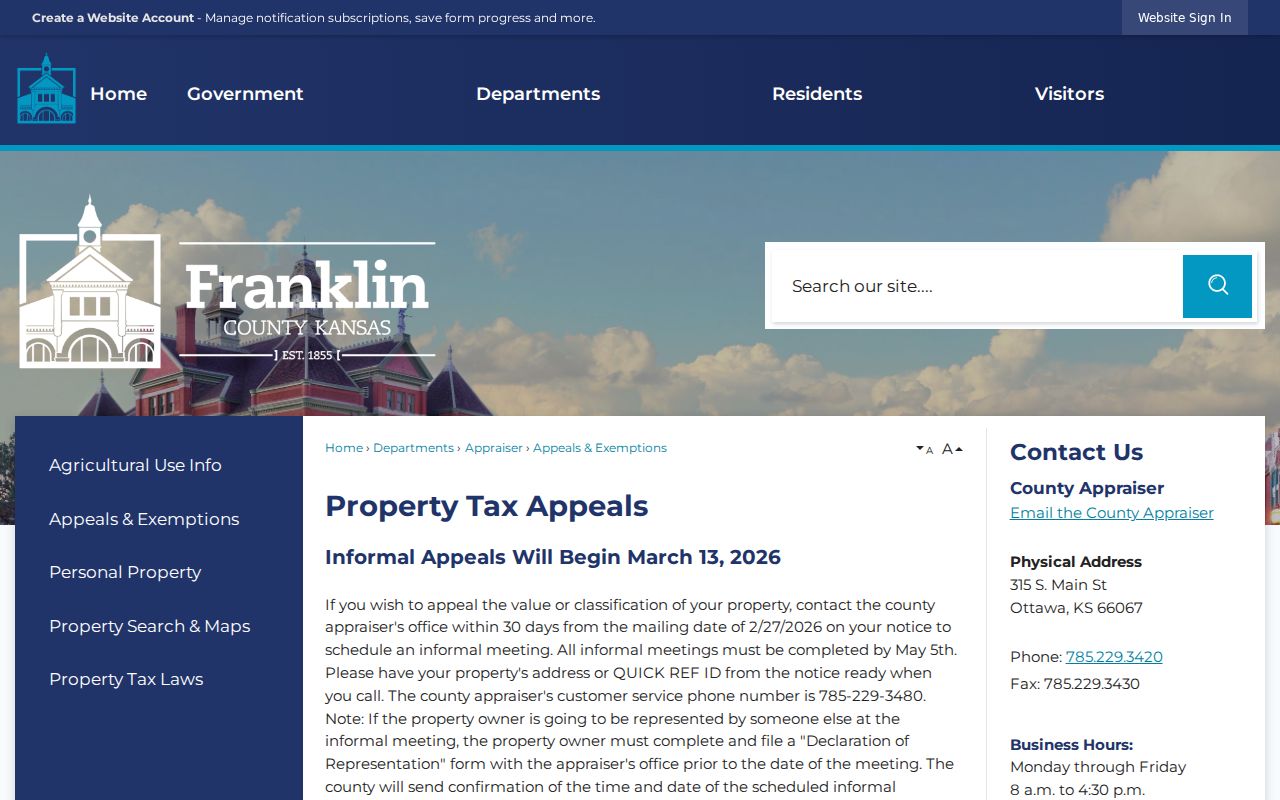
Keep the submission and any meeting or decision notice with the year's tax record.
After a decision, compare the revised parcel card and later tax statement against the written outcome. Preserve the notice, filed evidence, meeting record, decision date, tax year, and corrected property facts. If the account does not show an expected change, take the decision to the responsible office. Tyler will not reconcile every system at once. The Appraiser controls the value record. The Clerk maintains the roll. The Treasurer controls billing and collection.
Appeal window. Franklin County's published 2026 deadline was March 30. Check the current notice because dates change by cycle and a late filing may lose the route.